SS304 and Toughened Glass Railings for Durable, Stylish, Exterior Structures

Exterior railings carry more than visual weight. They protect edges, guide movement, face rain and pollution, and shape the first impression of a building. A railing that looks sharp on day one but stains, shakes, or feels unsafe after a few monsoons is a poor investment.
That is why stainless steel remains a preferred material for balconies, terraces, staircases, decks, bridges, and commercial façades. Among the many grades available, SS304 stands out as a practical choice for many exterior structures. When paired with toughened glass, it can create railings that are clean, strong, safe, and well suited to modern Indian homes and commercial buildings.

Stainless steel comes in several useful types
Stainless steel is not one single material. It is a family of iron-based alloys that contain chromium, usually along with nickel, carbon, molybdenum, manganese, or other elements. Chromium helps form a thin protective layer on the surface. This layer resists rust and can repair itself when exposed to oxygen, as long as the surface is clean and the environment is suitable.
Different stainless steels behave differently. Some are more corrosion resistant. Some are stronger. Some are easier to weld or polish. Choosing the right type matters for safety, appearance, and long-term maintenance.
Stainless steel type | Common grades | Key traits | Typical uses |
Austenitic stainless steel | SS304, SS316 | Excellent corrosion resistance, good formability, non-magnetic in annealed condition | Railings, kitchen equipment, architectural fittings, tanks |
Ferritic stainless steel | SS430 | Moderate corrosion resistance, magnetic, lower nickel content | Interior trims, appliances, decorative panels |
Martensitic stainless steel | SS410, SS420 | Hard and strong, lower corrosion resistance than 304 or 316 | Blades, tools, shafts, mechanical parts |
Duplex stainless steel | 2205 | High strength and strong resistance to chloride corrosion | Marine structures, chemical plants, heavy-duty industrial work |
Precipitation hardening stainless steel | 17-4PH | High strength with moderate to good corrosion resistance | Aerospace parts, valves, precision components |
For exterior railings, two grades often come up in discussions: SS304 and SS316. SS316 has molybdenum, which improves resistance to chloride attack. This makes it especially useful near the sea, around swimming pools, or in industrial areas with aggressive chemicals.
SS304, though, remains one of the most widely used grades because it offers a strong balance of corrosion resistance, workability, appearance, and cost. For most urban, residential, institutional, and commercial exterior applications away from heavy salt exposure, it performs very well when designed and maintained correctly.
SS304 offers a strong balance for exterior structures
SS304 is an austenitic stainless steel, commonly known for its 18 percent chromium and 8 percent nickel composition. Exact composition can vary within standards, but the chromium-nickel balance is what gives SS304 its well-known resistance to corrosion and its attractive finish.
For railings and exterior structures, its strengths are practical rather than theoretical. It works well on actual construction sites, with the kind of fabrication, finishing, and handling that railings require.
It resists corrosion in everyday outdoor conditions
SS304 handles rain, humidity, sunlight, and typical urban air better than mild steel or many coated metals. It does not need regular painting, and it does not rely on a surface coating that can peel away.
This is especially useful in Indian conditions, where exterior fittings may face:
Monsoon moisture
Dust and air pollution
Heat and UV exposure
Regular cleaning with water
Occasional contact with human hands, oils, and mild detergents
For a balcony railing in Bengaluru, Pune, Hyderabad, Delhi NCR, Ahmedabad, or many inland towns, SS304 can provide long service life with basic care. In coastal cities such as Mumbai, Chennai, Kochi, Mangaluru, Goa, or Visakhapatnam, SS304 can still be used in some settings, but SS316 or a more controlled maintenance plan is often better for highly exposed areas.
It has a clean finish that suits modern architecture
SS304 can be polished, brushed, satin finished, or mirror finished. This makes it useful across design styles.
A mirror finish can suit premium retail fronts, hotels, and showrooms. A satin or brushed finish often works better for homes, schools, hospitals, and housing societies because it hides minor handling marks more gracefully.
The material also pairs well with stone, concrete, wood, aluminium, and glass. It does not visually dominate the structure. Instead, it frames the building edge neatly.
It is strong enough for railing systems
Railings must resist daily use, accidental impact, and load from people leaning on them. SS304 offers good strength and ductility, which means it can take stress without becoming brittle. Fabricators can form it into posts, handrails, brackets, base plates, clamps, and custom profiles.
A strong railing is not only about material grade. It also depends on:
Correct tube thickness
Proper post spacing
Suitable anchoring into concrete or steel
Good welding and finishing
Safe glass thickness and fixing method
Compliance with local building requirements
A well-built SS304 railing system can feel solid under the hand and remain stable over years of use.

It is easy to clean and maintain
One reason SS304 is popular in kitchens, hospitals, food processing areas, and public spaces is hygiene. Its smooth surface does not trap dirt easily when finished well. For railings, this means easier cleaning and a better appearance over time.
Routine care is simple:
Wash with clean water to remove dust and deposits
Use a mild soap solution for oily marks
Wipe dry where water spots are visible
Avoid harsh acids, steel wool, and chloride-heavy cleaners
Clean more often in polluted or salty environments
Tea staining, a brown discolouration sometimes seen on stainless steel outdoors, can occur if deposits remain on the surface for long periods. Regular cleaning helps prevent it.
Toughened glass changes how railings look and perform
Toughened glass, also called tempered glass, is heat-treated to make it stronger than ordinary annealed glass. During manufacturing, the outer surface is put into compression and the inner core into tension. This gives the glass better resistance to impact and thermal stress.
If toughened glass breaks, it usually breaks into small blunt pieces rather than large sharp shards. That makes it safer than ordinary glass, although it still needs correct design and installation.
For railings, especially at height, laminated toughened glass is often preferred. It has two or more toughened glass layers bonded with an interlayer. If one layer breaks, the interlayer helps hold the broken pieces together and reduces the risk of an open gap.
This matters for balconies, staircases, atriums, terraces, malls, hotels, and public buildings where fall protection is critical.
Glass keeps views open
A solid parapet blocks sightlines. Horizontal bars can feel visually busy. Glass railings keep the edge safe while allowing open views.
This is one of the main reasons toughened glass is used in:
High-rise apartment balconies
Villa terraces
Resort decks
Cafés with outdoor seating
Poolside barriers
Commercial atriums
Staircases in showrooms and hotels
A terrace garden with glass railings feels larger because the eye travels beyond the edge. A sea-facing or lake-facing balcony gains value when the railing does not interrupt the view. Even a small urban balcony can feel less cramped with clear panels.
Glass improves daylight and openness
In staircases and internal courtyards, glass railings allow light to move through the building. This can reduce the heavy appearance of stairs and landings.
For example, a duplex home with an SS304 and glass staircase railing can look open without compromising the handhold. In a school or clinic, glass railings can help staff maintain visual supervision across levels. In a shopping arcade, transparent railings preserve display visibility from different floors.
Glass is easy to pair with different finishes
Toughened glass can be clear, frosted, tinted, or patterned. Clear glass is common for views. Frosted glass adds privacy. Tinted glass can reduce glare and suit certain façades.
When paired with SS304, the design options widen:
Frameless glass with SS304 spigots for a minimal look
Glass panels held by SS304 clamps and posts
Continuous SS304 handrail over glass for easy grip
Top-mounted railings for terraces and balconies
Side-mounted railings where floor space is limited
The choice depends on the building style, structural edge condition, budget, and safety requirement.
SS304 and toughened glass work well together
The combination of stainless steel and glass has become a standard in premium railing design because each material solves a different problem. Steel gives structure, grip, and fixing strength. Glass gives transparency, enclosure, and a lighter visual feel.
Together, they create railings that are practical and refined.
They create a modern exterior without excess decoration
SS304 frames glass cleanly. It does not need ornate patterns to look finished. A simple round or square handrail, neat posts, and clear glass panels can suit both residential and commercial architecture.
This is useful for buildings where the exterior already has strong materials such as granite, textured plaster, exposed concrete, or natural stone. The railing should support the design, not compete with it.
For a villa terrace, SS304 posts with clear glass can highlight the garden view. For a retail building, a mirror-polished handrail can add a premium feel near the entrance. For an apartment balcony, a satin finish can look elegant while staying practical.
They improve durability when specified correctly
Both SS304 and toughened glass resist weathering better than many traditional railing materials. Mild steel railings can rust if their paint layer fails. Wood needs regular sealing and can warp outdoors. Aluminium is light and corrosion resistant, but it may not always provide the same premium feel or repair flexibility.
SS304 and glass systems can last well when the design avoids common mistakes:
Water should not collect inside hollow sections
Welds should be cleaned and passivated where required
Dissimilar metal contact should be controlled
Glass edges should be properly finished
Gaskets and setting blocks should suit outdoor use
Anchors should match the base material and load
A railing is an assembly. Its weakest detail often decides its service life.
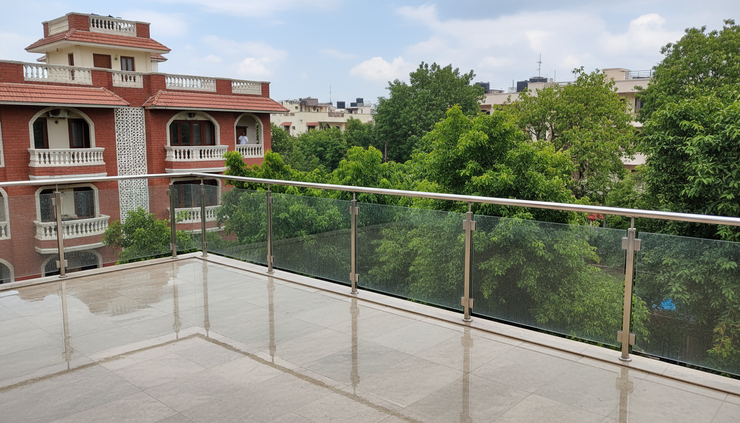
They support safety without making spaces feel closed
Safety railings can sometimes make balconies and staircases feel boxed in. Glass avoids that problem. It protects the edge while keeping the space visually open.
For children, pets, and public users, glass panels also reduce climbable gaps compared with many horizontal railing designs. That said, safety depends on the full system. Panel height, handrail design, glass type, fixing method, and installation quality all matter.
For high-rise balconies and public spaces, project teams should follow applicable building codes and use structural guidance from qualified professionals. In many cases, laminated toughened glass is the safer choice for locations where breakage could create a fall hazard.
Practical applications across homes and commercial spaces
SS304 and toughened glass railings fit many building types because they can be adapted to different levels of exposure, traffic, and design intent.
Apartment balconies
In apartment buildings, railings need consistency, safety, and low maintenance. SS304 posts with toughened or laminated toughened glass panels can give each balcony a clean appearance while keeping the façade light.
For upper floors, glass selection and anchoring become especially important. Laminated toughened glass, continuous handrails, and tested fixing details can improve safety.
Villa terraces and decks
Terraces often function as outdoor living spaces. A bulky railing can interrupt the view and reduce the feeling of openness. SS304 and glass railings work well around terrace gardens, sit-outs, pergolas, and decks.
A brushed SS304 finish is often practical here because it hides fingerprints and minor marks better than a mirror finish.
Staircases and landings
Indoor and semi-outdoor staircases benefit from the same pairing. Glass panels can make a staircase look lighter, while SS304 handrails provide a comfortable grip.
In commercial staircases, the handrail should be easy to hold, continuous where possible, and fixed firmly. Glass should never be treated as decoration alone if it forms part of the safety barrier.
Hotels, cafés, and resorts
Hospitality spaces use railings as part of the guest experience. Pool decks, rooftop cafés, sea-facing restaurants, and garden walkways often need safety without blocking the view.
SS304 and glass can create a polished look that photographs well and stands up to heavy use. In poolside or coastal areas, SS316 may be the better steel grade, especially where chlorides are present.
Hospitals, schools, and public buildings
In public buildings, railings need to be durable, easy to clean, and safe for frequent use. SS304 is well suited to many such settings because it handles regular cleaning and does not require paint touch-ups.
Glass panels can improve visibility in staircases and corridors, but the design should control breakage risk, edge exposure, and user impact.
How to choose the right railing specification
A good specification starts with the site, not the catalogue. Before choosing a railing design, assess exposure, use, safety level, and maintenance access.
Use this simple decision guide:
Site condition | Better choice |
Inland residential balcony | SS304 with toughened or laminated toughened glass |
High-rise balcony | SS304 or SS316 with laminated toughened glass, subject to design checks |
Coastal or poolside location | SS316 is often preferred over SS304 |
Heavy public use | Thicker sections, strong anchors, laminated toughened glass, easy-grip handrail |
Premium exterior façade | Brushed or mirror SS304 with clear glass |
Privacy-focused balcony | SS304 with frosted or tinted toughened glass |
The finish also matters. Mirror-polished stainless steel looks striking but shows fingerprints and water marks more easily. Brushed or satin finishes are often easier to live with outdoors.
Glass thickness should not be guessed. It depends on panel size, fixing type, height, wind load, and expected use. For critical installations, ask for proper design calculations and follow local norms.
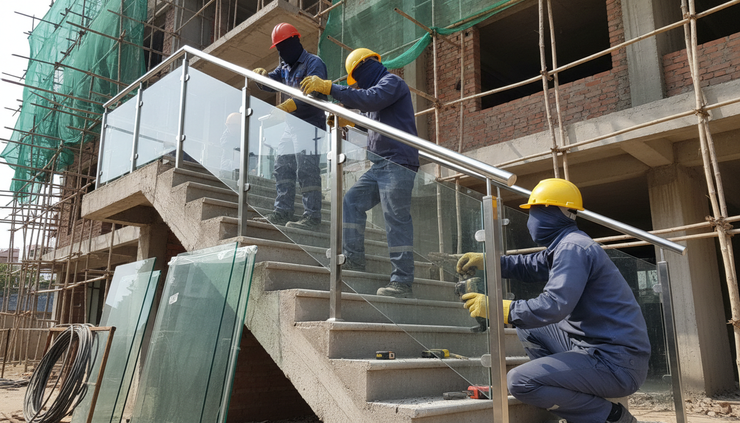
A durable railing starts with good details
SS304 and toughened glass can produce railings that look refined and last for years, but only when the small details are handled properly. Material selection is the starting point. Fabrication, anchoring, drainage, cleaning, and glass safety complete the system.
For most exterior structures away from severe chloride exposure, SS304 offers an excellent balance of corrosion resistance, strength, finish quality, and value. Toughened glass adds openness, light, and a premium appearance. When the project involves height, public access, or higher risk, laminated toughened glass and professional structural design become essential.
A well-made railing should feel steady, clean easily, protect users, and improve the building’s appearance without demanding constant attention. That is the real strength of SS304 and toughened glass together: they make safety look simple.


Comments